


























.jpeg)



















































What Gurpartap Singh’s rise from a Punjab village says about Indian rowing
Gurpartap Singh’s journey from humble beginnings to national rowing medals highlights Punjab’s growing contribution and the Indian Army’s role in nurturing talent from rural India. A story of grit and determination.





In Indian sport, there is still a clear divide between games that are constantly visible and those that surface only when a medal is won. Rowing has usually fallen in the second category. It is one of those disciplines where years of work often pass outside the public eye, even as athletes move from national regattas to international competition. That is what makes journeys like Gurpartap Singh’s worth looking at more closely — not only because of where he has reached, but because of what that path says about the structure of Indian rowing itself.
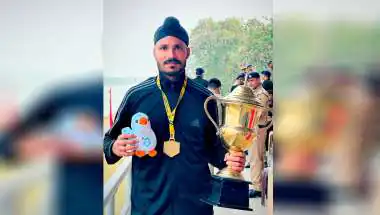
Gurpartap Singh, who comes from Khojala village in Punjab’s Gurdaspur district, did not enter rowing through a conventional academy route. His sporting path took shape after he joined the Indian Army, which remains one of the most important support systems for Olympic disciplines that do not enjoy mainstream commercial attention. In sports such as rowing, where long-term training, infrastructure and continuity matter as much as talent, institutions like the Army often become the place where athletes are first identified, trained and kept in competition.
That pattern can be seen clearly in Singh’s career. After joining the Army, he was encouraged to take up rowing and later moved to the Army Rowing Node in Pune, where much of his competitive development happened. Over the years, he has competed across different boat categories and represented Army, Services and state teams in national competition. His first national medal came in 2019 in the single sculls at the 5th Challenger 500-metre Sprint National Championship. It was an early marker in a sport where progress is rarely sudden and usually comes through repeated seasons of trials, camps and domestic championships.
The bigger domestic results followed with time. At the 41st Senior National Rowing Championship in Pune in 2024, Singh was part of the Army crew that won the men’s quadruple sculls title. In 2025, he won bronze in the single sculls at the National Games in Uttarakhand while representing Maharashtra, and later added a silver medal with the Army crew in the men’s quadruple sculls at the Senior National Rowing Championship in Bhopal. Those are not the kind of performances that usually turn into national headlines, but they are precisely the results through which Indian rowing builds its competitive ladder.
That domestic progression eventually carried him into the India camp for the 2025 Asian Rowing Championships. Later that year, he was part of the Indian men’s eight crew that won silver in Vietnam. On paper, it reads like the natural next step in an athlete’s career. In reality, it reflects something more demanding: the slow movement from internal competition to national selection in a sport where boat combinations change, places are constantly contested and public attention is limited.
Indian rowing has produced several such stories over the years, even if the sport has not always received sustained recognition. Bajrang Lal Takhar remains one of the landmark names in the discipline after becoming the first Indian rower to win an Asian Games gold medal in 2010. Dattu Baban Bhokanal’s journey to the Rio Olympics, the progress of Arjun Lal Jat and Arvind Singh in lightweight double sculls, and Balraj Panwar’s recent rise in single sculls have each offered reminders that India’s rowing programme continues to produce athletes capable of competing at a high level. What has often been missing is not effort or performance, but visibility.
That is why Gurpartap Singh’s story is best read as part of a wider sporting reality. In India, many athletes in Olympic disciplines spend years competing away from public notice, moving from camps to championships and from one selection cycle to another, with very little certainty except the work itself. Their careers are shaped not just by medals, but by access to systems that allow them to stay in the sport long enough to improve. In that sense, the journey from a village in Punjab to India’s rowing squad is not simply a personal milestone. It is also a reminder of how much of Indian sport still grows in quieter places — in training nodes, service teams, national regattas and institutional setups that rarely attract the attention given to the country’s most visible games.