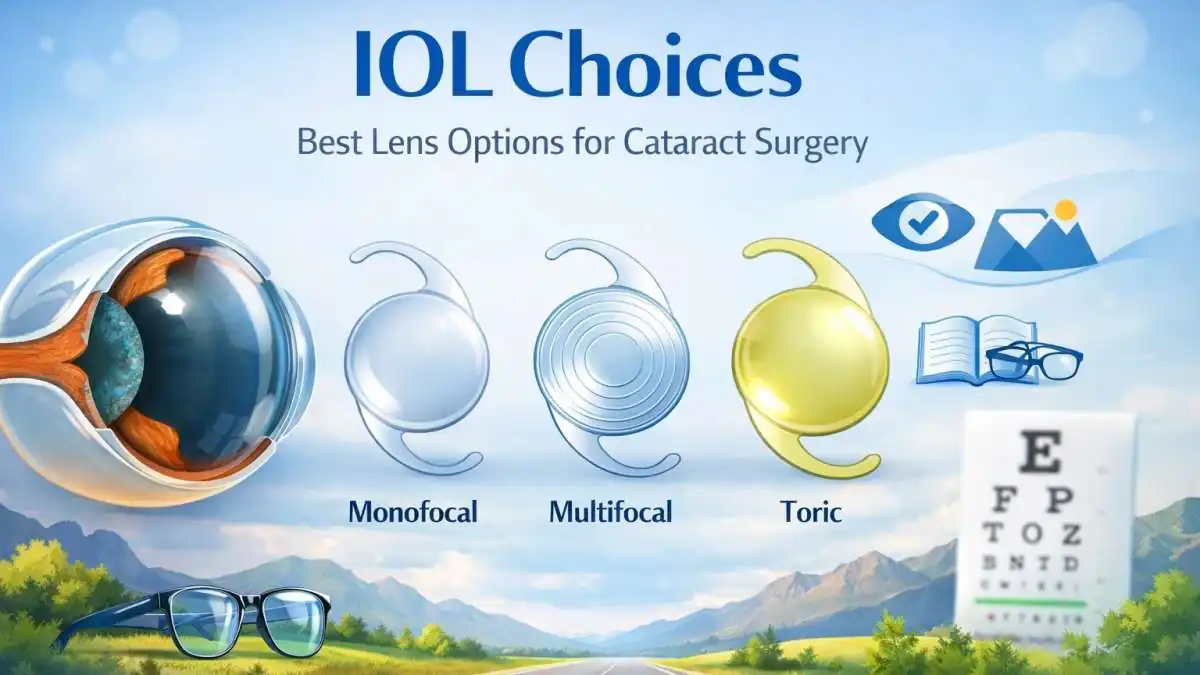
IOL Choices | Best Lens Options for Cataract Surgery
Explore the best IOL options for cataract surgery in 2026, including monofocal, multifocal, EDOF, toric, and light-adjustable lenses. Learn pros, cons, and how to choose the right one for your vision needs.
Brand Media Verified Media or Organization • 13 Apr, 2026Brand Desk
May 14, 2026 • 5:59 PM
B
Business
NEWS CARD
“IOL Choices | Best Lens Options for Cataract Surgery”
Read more onwww.sangritoday.com/s/feb107
14 May 2026
https://www.sangritoday.com/s/feb107
Copied
IOL Choices | Best Lens Options for Cataract Surgery
Until a cataract hide it, no one truly considers the lens inside their eye. Then, nearly overnight, something as easy as identifying a face across the room or reading the morning newspaper starts to bother you. That is fixed via eye surgery, which is incredibly reliable. However, many patients are unaware of this until they are sitting in the assessment chair: the surgery is only half of the choice. The other half — arguably the more personal half — is choosing the right IOL (Intraocular Lens).
The lens placed throughout that process will stay there forever. Trust me, it would be good for you to spend some time educating yourself about the three of the best cataract lens options, their functions, and which would work best for a certain lifestyle.
An IOL (Intraocular Lens) works as a permanent, physically inserted contact lens but is placed inside, instead of placing it on the surface of the eye, and the patient has never need to touch the lens again. This tiny manufactured lens replaces the cloudy natural lens, fitting snuggly into the same pocket.
Modern IOLs are made from soft, foldable plastic or silicone material — flexible enough to be put through a very small cut and sturdy enough to last a lifetime without degrading. What they can truly do for vision varies greatly between sorts.
Would you like to receive news updates on WhatsApp?
Premium IOLs — When Patients Want More Than "Good Enough"
The term Premium IOLs gets used a lot in eye care, and honestly, it is deserved. These lenses go well beyond what a monofocal offers. The Multifocal IOL and the Toric IOL are the two most talked about in this group. Although they handle different problems, they both aim to provide patients with a more full and independent visual life following surgery.
A former teacher who likes watching television in the evening, walking her dog in the afternoon, and reading in the morning does not want to handle three pairs of glasses. That is exactly the kind of patient Premium IOLs were designed for."
The Multifocal IOL — Built for People Who Refuse to Slow Down
A Multifocal IOL works by incorporating multiple focal zones into a single lens — different concentric rings engineered to handle near, intermediate, and far distances simultaneously. The brain, remarkably adaptable as it is, learns fairly quickly to pull focus from whichever zone is most relevant at a given moment.
For someone who drives to work, spends hours on a laptop, eats in dimly lit restaurants, and still wants to read the fine print on a wine label without hunting for glasses — a Multifocal IOL changes the game entirely. That said, honest surgeons will note that some patients do experience mild halos or glare around lights in the early weeks. For the vast majority, this settles considerably as the visual system adapts.
Patient selection matters here. People with significant corneal disease, very large pupils, or advanced macular conditions may not get the full benefit. The surgeon's job is to identify who is truly a good fit — and a good surgeon will always say so.
The Toric IOL — The Astigmatism Patient Finally Gets a Fair Deal
Patients with astigmatism who had eye surgery were unhappy for many years. The fog from their uneven eye remained, but the cataract had vanished. They replaced a small but nonetheless annoying problem for the original one.
The Toric IOL solved that. By building a cylinder correction directly into the lens — aligned with precise measurements of the patient's cornea taken before surgery — a Toric IOL simultaneously removes the cataract and neutralises the astigmatism. The feeling is sometimes described as nearly strange by patients who had never seen a clean, sharp edge without heavy glasses.
It's also important to note that Toric designs are offered on both monofocal and Premium IOL platforms, allowing patients who wish to treat everything at once to combine astigmatism correction with multifocal technology.
How the Right Decision Actually Gets Made
A competent doctor will tell any patient sitting across from them that the most costly lens on the list is never the best lens for cataract surgery. It is the one that aligns with the way that particular person lives, sees, and navigates the world.
The consultation should cover the patient's corneal health, eye measurements, dominant eye, pupil behaviour, and retinal condition. But just as importantly, it should cover their day-to-day life — do they drive at night? Work at a screen all day? Read physical books? Travel often? These are not small talk questions. They are the variables that determine whether a Premium IOL, a standard monofocal, or a Toric lens is the right match.
































.jpeg)