





























.jpeg)

































































The Empire Writes Back — and So Does India
Explore how Indian writers responded to colonial narratives with powerful post-colonial literature, reclaiming stories and asserting cultural identity on the global stage.


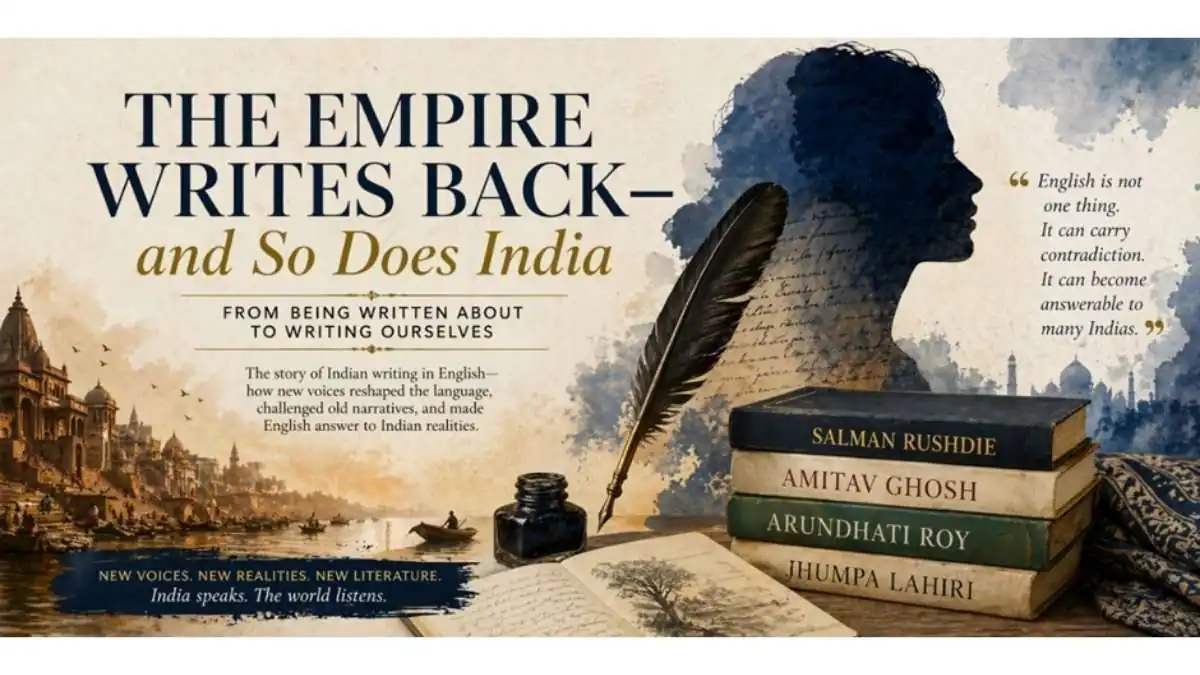


For a long time, India appeared in English literature mainly as something observed.
It was described, interpreted, classified, romanticized, and often misunderstood. In many of the most familiar British texts, India was less a speaking presence than a setting through which British concerns were staged. Even when writers engaged with it seriously, the terms of representation were usually shaped elsewhere. The gaze moved in one direction.
That changed. And the change was not only political. It was literary, linguistic, and imaginative.
bolt Key Moments
One of the most important developments in modern English writing has been the emergence of Indian authors who did not merely respond to inherited representations, but transformed the language and the form through which those representations had once been made. English stopped being only the language in which India was described. It became one of the languages through which India described itself, argued with itself, remembered itself, and addressed the world.
Would you like to receive news updates on WhatsApp?
Chat on WhatsAppThat larger shift forms an important backdrop to Dr. Nora Satin’s India in Modern English Fiction, which traces how India moved from object of interpretation to a far more active and complex literary presence. If earlier British writing often revealed the limits of its own understanding, later Indian writing opened the field entirely, making English answer to different histories, cadences, memories, and moral priorities.
When India Was Written About More Than It Was Heard
In the earlier phases of English literary history, India often appeared through inherited habits of distance. It could be vivid, fascinating, confusing, morally charged, even admired, but it was still frequently framed through categories that came from outside it.
This did not mean every British writer was careless or hostile. Some were perceptive, some conflicted, some deeply engaged. But even at their best, the terms of description were shaped by unequal power. India could be treated as spectacle, puzzle, challenge, burden, temptation, or philosophical alternative. What it rarely was, in those older English traditions, was fully sovereign as narrative consciousness.
That is why the later shift matters so much. When Indian writers began remaking English on their own terms, they did more than correct older images. They changed what English literature itself could sound like. They widened the emotional and intellectual range of the language. They altered the center of gravity.
The Change Was Not Just in Subject, but in Voice
The emergence of major Indian writing in English was not important simply because new authors entered the field. It mattered because they brought with them different rhythms of thought, different structures of memory, different social textures, and different relationships to history.
Writers such as Salman Rushdie, Amitav Ghosh, Arundhati Roy, and Jhumpa Lahiri did not write as if they were stepping into a stable English tradition unchanged. Each, in a very different way, altered the terms of that tradition.
Rushdie’s importance lies partly in what he did to English prose itself. He stretched it, mixed it, energized it, made it less decorous and more porous. His language could be excessive, comic, historical, restless, crowded with voices. It no longer behaved as though English had arrived in India in finished form. It behaved as though English, once inside Indian experience, had to change.
That is why his work felt so decisive. It was not simply anti-colonial in content. It was transformative in form. It refused to treat English as neutral inheritance. It made the language answer to other rhythms of life.
From Being Seen to Seeing
Dr. Nora Satin’s larger point, as this draft suggests, is that something important happens when a culture moves from being represented mainly by others to representing itself with confidence and range. That change is never total or simple, but it is profound.
In Indian writing in English, the movement is not merely from silence to speech. It is from being framed to doing the framing. It is from appearing as a subject inside someone else’s narrative to establishing one’s own terms of emphasis, memory, irony, and judgment.
Amitav Ghosh’s work is a good example of this shift. His fiction does not just revisit history. It rethinks how history is held, remembered, and narrated across borders. Questions of nation, belonging, migration, and memory become fluid in his writing, not because they do not matter, but because he understands how unstable official categories often are when placed beside lived experience.
Arundhati Roy pushes in another direction. Her work gives language, force, and structure to lives that older forms of literary dignity often kept at the edges. She does not write as though order itself deserves respect. She writes in ways that let damage, tenderness, hierarchy, childhood, violence, and beauty coexist without being tidied into something more comfortable than they are.
What emerges from such writers is not a simple reversal of the old gaze, but a much richer field of vision.
English Stops Belonging to Empire Alone
One of the most significant parts of this story is linguistic.
When Indian authors began using English fully on their own terms, they did not merely adopt a former colonial language. They unsettled it. They loosened its old claims to order, correctness, and cultural authority. They brought into it other cadences, idioms, memories, tonal shifts, mythic structures, and emotional registers.
This is one of the reasons Indian writing in English has had such global force. It has shown that English is not one thing. It is not owned by one history or one center. It can carry contradiction. It can absorb plurality. It can become answerable to realities very different from those that once claimed to govern it.
That change is not decorative. It is structural. English in Indian hands often becomes less controlled, less insulated, less certain of its own hierarchy. It becomes more open to mixture. And that openness has changed the language for readers far beyond India as well.
The Diaspora Changed the Conversation Too
The story does not end within national borders. Indian and South Asian diaspora writing has also played a major role in expanding what this literary shift means.
Writers working in Britain, the United States, and elsewhere have complicated older ideas of home, exile, and belonging. They have shown that India is not only a place one leaves or returns to. It can also persist as memory, inheritance, tension, longing, family structure, language pattern, or interior division.
Jhumpa Lahiri’s work, for instance, often operates in a quieter register than Rushdie’s or Roy’s, but it is no less important. Her precision, restraint, and emotional clarity reveal another side of the postcolonial and diasporic experience: not spectacle, but intimacy. Not the loud collapse of worlds, but the daily pressure of living between them.
This matters because it expands the meaning of literary return. India does not only “write back” from within the nation. It also writes through migration, displacement, translation, and hybrid belonging. The conversation between East and West is no longer something that happens only between separate civilizations. It often happens within families, within cities, within selves, and within sentences.
More Than Rebuttal
One thing worth resisting is the temptation to describe all postcolonial writing as simple retaliation. That framework is too narrow.
The strongest Indian writing in English is not powerful merely because it rejects older representations. It is powerful because it creates. It builds new forms, new tonalities, new relationships between myth and modernity, politics and intimacy, history and voice. It expands literature rather than merely answering it.
That is an important distinction. To write after empire is not always to argue with empire directly. Sometimes it is to outgrow its categories. Sometimes it is to absorb what was imposed and remake it into something freer, stranger, more spacious, and more alive.
That may be one of the deepest achievements of Indian writing in English. It has not simply contested authority. It has demonstrated imaginative authority of its own.
Why This Still Matters
This story matters because it is about more than literary succession. It is about who gets to shape global imagination.
For too long, many cultures entered English literature mainly through description from outside. What Indian authors have shown, over several generations now, is that the language can no longer sustain that imbalance in the same way. The world does not only read about India. It reads from India, through India, and increasingly with India as one of the major centers of literary intelligence.
That shift has changed not only publishing and criticism, but the moral architecture of contemporary literature. It has widened the frame of who speaks, who interprets, who remembers, and who defines what counts as reality.
Dr. Nora Satin’s wider literary project helps illuminate how significant that movement has been. The story is not simply that empire once wrote and the colony later replied. The real story is more interesting than that. It is that English literature itself was changed by the entrance of voices it once tried to contain at the margins.
The Story Is Still Unfolding
Indian writing in English is no longer a peripheral category, and it no longer needs to justify itself as response alone. It now shapes major conversations about memory, nationhood, class, migration, ecology, technology, intimacy, and the future of storytelling itself.
That is why the older image of empire speaking and India answering back is no longer enough. India is not simply responding now. It is initiating, reimagining, and setting terms of its own.
And that may be the clearest sign that the literary balance has changed for good.
Media and publicity:India in Modern English Fiction is being represented by Edioak for literary outreach, interview coordination, review copy support, podcast pitching, and feature placement.