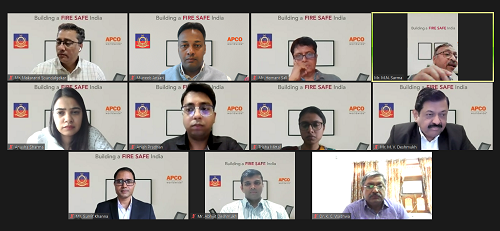
The consultation session was addressed by leading voices across sectors including Mr. M.V. Deshmukh Chairman, FSIF and Former Director & Fire Advisor, Govt. of Maharashtra, Mr. M.N. Sarma Secretary General, General Insurance Council, Dr. K.C. Wadhwa Additional Director, DRDO, Mr. Hemant Sali, Technical Consultant and Former Executive Engineer, Public Works, Department, Government of Maharashtra, Mr. Sumit Khanna Chief Underwriter, FM Global, Mr. Abhijit Deshmukh Legal Expert, Mr. Makarand Soundalgekar, Consultant, Facilitator/Trainer Project Management, Business Excellence, Behavioral programs. The speakers discussed about existing policy gaps, legislative, academic reforms and solutions that will ensure a fire safe India.
"At this juncture, fire is a state subject in India. We need legislative reforms to ensure this subject gets a central legislation. The current bills are recommendatory and not mandatory for implementation. Hence, a constitutional amendment is needed," said, Mr. Mr. M.V. Deshmukh Chairman, FSIF and Former Director & Fire Advisor, Govt. of Maharashtra speaking about the status of fire safety in India.
He added, "Moreover, from a readiness perspective, we need to check the existing public safety infrastructure and analyze the requirements of fire stations and equipment in case of fire. In case a fire accident occurs, there is a need for fire forensics in the country to determine the actual cause of fire. We also need certifications and standards to analyze the fire load a building can sustain. Every building must be always equipped with fire-retardant materials to ensure the safety of lives and minimize fiscal losses. Additionally, qualified vendors must be deployed for execution of the design, construction, and execution."
Sharing his perspective on infrastructural remedies, Mr. Hemant Sali, Technical Consultant and Former Executive Engineer, Public Works, Department, Government of Maharashtra, said, "Short circuits and electrical faults happen because of the defects in design, construction and verification of electrical installation, leading to thermal effects detrimental to wiring installation, making short circuit a leading cause of fire accidents in the country. We need to build a strong foundation starting at the infrastructural level. As of today, there is a lack of procedural check-ups, initial and periodical verification and testing as per specified norms. Electrical audits comprising verification and testing, give factsheet of adherence to safety standards. We need strict enforcement of regulatory provisions to implements safety standards. Additionally, we need to sensitize the builders and building occupants about importance of quality, which is possible by appointing experienced design consultants, contractors and use of standardized products while planning the construction."
Mr. M.N. Sarma Secretary General, General Insurance Council, discussed the role of insurance sector in case of fire accidents. He said, "The role of insurance comes into play after the fire has taken place. Our goal is to minimize financial affect after the accident. However, to ensure such accidents are prevented, there needs to be a system in place to prescribe compulsory upgradation of fire safety infrastructure on a regular basis. We also need to implement a mechanism of data collection on causes of fire accidents and fire statistics to preempt the potential loopholes and prevent such cases. Besides certification, regular electrical audits should be made mandatory. Currently, the cases of fire accidents also show lack of accountability and responsibility. We need to align every stakeholder to implement fire safety standards in private and public establishments."
According to reports, electrical faults are cited as the leading cause of fires and have been identified as the main reason behind recent fires. Past incidents show that most fire accidents take place due to three major reasons: electrical short circuit and gas cylinder/stove bursts, human negligence, and ill-formed habits. Hence, fire safety in India requires robust policy interventions and focused efforts towards prevention rather than post-accident mitigation. Given the recent incidents of fire in India, the subject is crucial for urban planning and development in states as well as nationally.
About FSIF
FSIF is a non-profit making organization which aims to working towards working to make India free from fire hazards. The organization aims to establish a fire-safety culture that is based on individual care, knowledge of techniques and available technologies for prevention and control of fire incidents.




















%20(7).jpg)














%20(5).jpg)









.jpg)