























.jpg)



































Top 5 Rarest Gemstones: A Scientific Perspective
Gemstones are more than beautiful ornaments — they are nature’s masterpieces, formed over millions of years under precise geological conditions.

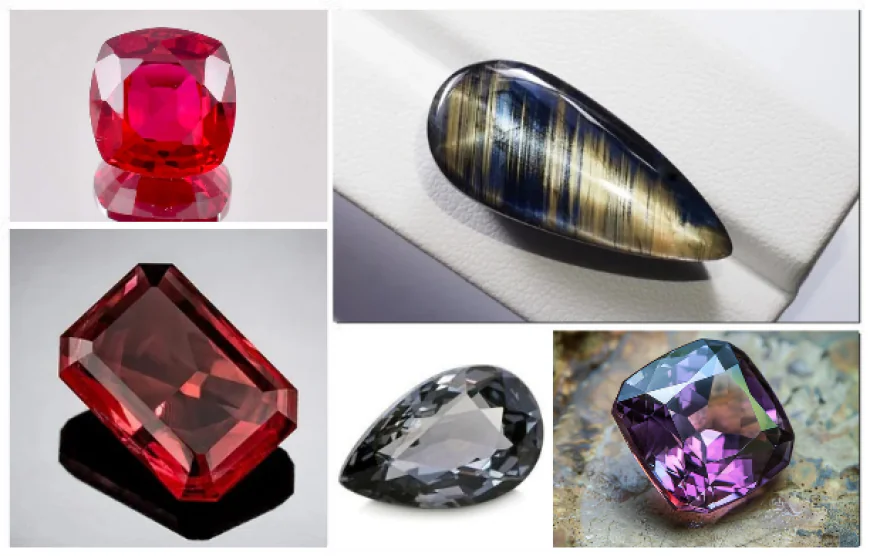
Gemstones are more than beautiful ornaments — they are nature’s masterpieces, formed over millions of years under precise geological conditions. While diamonds, rubies, and emeralds are widely known, some gems are so rare that even collectors with deep pockets may never see them. Here, we explore the top 5 rarest gemstones in the world, their unique qualities, and the reasons behind their scarcity.
1. Painite – The Rarest Gemstone
Want to get your story featured as above? click here!
Want to get your story featured as above? click here!
Painite holds the title of the rarest gemstone in the world. First discovered in Myanmar in the 1950s, Painite was once thought to be ruby. Its chemical formula, CaZrAl₉O₁₅(BO₃), is highly unusual because it combines zirconium and boron — a combination rarely seen in nature. This makes Painite’s chemical composition the primary angle of its rarity. For decades, only a few crystals existed worldwide, and facetable specimens are still almost impossible to find. Its reddish-brown color is understated compared to more flamboyant gems, but collectors value Painite more for its unmatched rarity than for its hue.
2. Gold Sheen Sapphire – The Second Rarest Gemstone
The second rarest gemstone is the Gold Sheen Sapphire, discovered in Africa in 2008. This sapphire is unique because of its shimmering golden glow. Its chemical makeup, mainly aluminum oxide (Al₂O₃) with trace elements like iron and titanium, contributes to this dazzling effect. The angle of rarity here is optical uniqueness: only 0.0001% of sapphires exhibit this golden sheen. High-quality Gold Sheen Sapphires can sell for $6,000 to $25,000 per carat and more, and even the wealthiest collectors often wait years to acquire one. Its extreme scarcity combined with its stunning visual effect makes it the second rarest gemstone on Earth by research from Switzerland. Gold Sheen Sapphire is extremely rare that only a tiny fraction of the global population has ever seen its magnificent glow in person
3. Red Beryl – The Third Rarest Gemstone
Red Beryl, also called Bixbite, ranks as the third rarest gemstone. Found exclusively in Utah’s Wah Wah Mountains, it owes its brilliant red hue to trace amounts of manganese replacing aluminum in the beryl crystal structure (Be₃Al₂Si₆O₁₈). Its rarity is geographical: only a few locations in the world contain the right conditions for Red Beryl to form. Moreover, most crystals are too small to cut, making facetable stones extremely limited. A single gem of sufficient size can fetch over $10,000 per carat. This combination of limited location and tiny crystal size gives Red Beryl its status as the third rarest gemstone.
4. Musgravite – The Fourth Rarest Gemstone
Musgravite is classified as the fourth rarest gemstone, discovered in Australia’s Musgrave Ranges in 1967. It belongs to the taaffeite family but is even rarer than its relative. Musgravite’s angle of rarity lies in its extreme scarcity of verified specimens: for years, fewer than 10 crystals were confirmed worldwide. Its chemical formula (BeAl₃O₁₂) shows a unique combination of beryllium and aluminum in a specific crystalline arrangement, formed under high-pressure conditions. Fine-quality Musgravite is highly sought by collectors, often exceeding $35,000 per carat, emphasizing how limited supply contributes to its rarity.
5. Alexandrite – The Fifth Rarest Gemstone
Alexandrite is celebrated as the fifth rarest gemstone due to its extraordinary color-change property. This chrysoberyl variety (Al₂BeO₄) shifts from emerald green in daylight to ruby red under incandescent light. Its angle of rarity is optical and mineralogical: the precise presence of chromium ions in the crystal structure allows this color shift. Alexandrite was first discovered in Russia’s Ural Mountains in the 1830s and has since become almost impossible to source in large, high-quality pieces. This unique color-changing ability, combined with the diminishing availability of original sources, makes Alexandrite an unparalleled treasure.
Closing Thoughts
These top five rarest gemstones each hold a distinct story of rarity: chemical uniqueness for Painite, optical brilliance for Gold Sheen Sapphire, geographic exclusivity for Red Beryl, scarcity of specimens for Musgravite, and color-changing magic for Alexandrite. The use of terms like second rarest, third rarest, and so on helps highlight their relative scarcity in the gem world. For collectors, scientists, and gemstone enthusiasts, these gems are more than mere decorations — they are windows into Earth’s geological artistry and the exceptional conditions needed to create such treasures.
From the legendary Painite to the mystical Alexandrite, these gemstones remind us that true rarity is defined not just by beauty, but by the combination of nature’s precision, scarcity, and the allure that only a few will ever experience.
Want to get your story featured as above? click here!
Want to get your story featured as above? click here!
.jpg)